Devices and firmware
Embedded software for microcontrollers, sensor integration, power management and secure boot. We work with ARM Cortex, ESP32, STM32 and Nordic platforms among others.
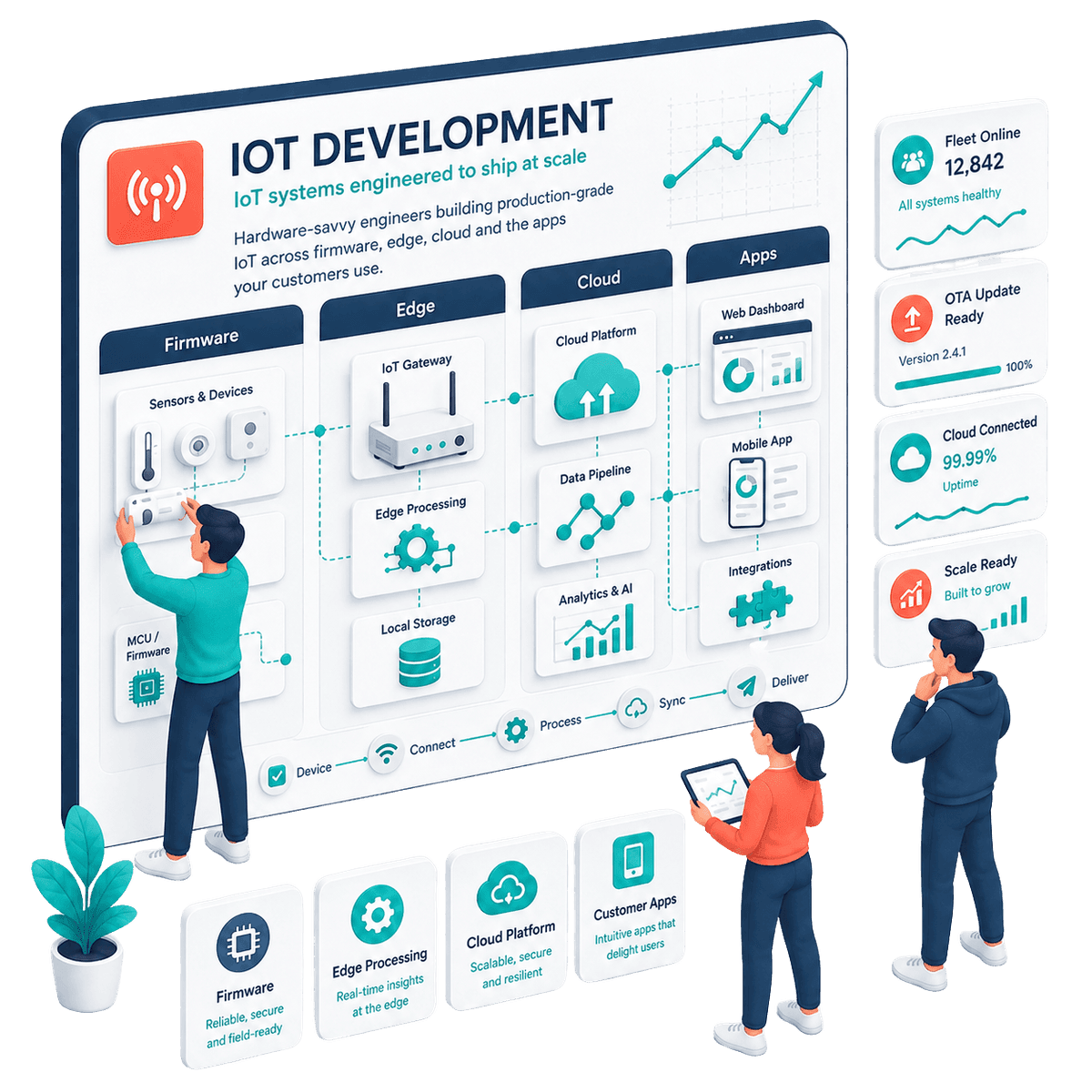
IOT DEVELOPMENT
Hardware-savvy engineers building production-grade IoT across firmware, edge, cloud and the apps your customers use.
5 layers
Firmware to cloud to customer app
Fixed price
Staged discovery and prototype pricing
Japan-managed
Hardware and software delivery
THE STACK
Most IoT projects need work across five layers. We engineer all of them.
Embedded software for microcontrollers, sensor integration, power management and secure boot. We work with ARM Cortex, ESP32, STM32 and Nordic platforms among others.
Cellular, WiFi, BLE, LoRa, Zigbee, NB-IoT. We help pick what fits your range, power and data needs, then implement the protocols at the device and gateway level.
AWS IoT, Azure IoT Hub, GCP IoT or custom MQTT brokers. Device authentication, message routing, time-series storage and the integrations that pipe data into your existing systems.
Mobile apps for end users, web dashboards for operations teams and BI tools for analytics. Built on the same React, React Native and Flutter stack our software team uses.
OTA firmware updates, fleet management consoles, remote debugging tools and version control across deployed devices. Designed in from the start so operations runs smoothly once devices are in the field.
WHERE IT'S USED
Connected hardware with a companion app, cloud sync and OTA updates. Wearables, home devices, fitness equipment and connected vehicles.
Sensor networks for OEE monitoring, predictive maintenance, machine-to-machine communication and shop-floor dashboards.
Asset trackers, fleet telematics, warehouse positioning and cold chain monitoring, with battery-aware firmware and resilient connectivity.
Utility metering, environmental sensors, energy grid monitoring and smart city deployments where reliability across thousands of nodes is non-negotiable.
WHY IT'S DIFFERENT
IoT runs on physical timelines. Hardware lead times, certification cycles and field deployment realities shape every project, and we plan around them up front.
New board orders take four to twelve weeks. We build firmware in parallel with hardware availability so progress continues while units arrive.
FCC, CE and MIC for Japan, plus industry-specific certs for medical, automotive or industrial use. We scope the pathway during discovery so it lands inside the project timeline.
Devices live in real environments with bad signal, dust, temperature swings and end users who just want the thing to work. Ruggedness and graceful failure modes get designed in early.
Devices at scale need a firmware update path that works for a single unit and a fleet of 50,000. The OTA strategy is built into discovery, with the update flow locked in before production design begins.
HOW IT RUNS
Two to four weeks covering hardware selection, comms protocol, cloud platform, security model and compliance pathway. Output is a written technical scope and quote.
Fixed-price build of the proof-of-concept. Working firmware, cloud and a small number of physical units validate the approach before production commitment.
Final hardware bring-up, firmware hardening, cloud platform, apps and certification support. Delivered in phases from our Sri Lanka engineering team, with sign-off between each.
Limited fleet deployed in real conditions with monitoring data flowing back. Adjustments made before full rollout, then scaled to production volume with ops support in place.
PRICING
IoT projects move in stages, so we price in stages.
01
Fixed price for two to four weeks of feasibility work covering hardware selection, comms, cloud, compliance and a written scope.
02
Fixed price for the proof-of-concept, including software plus a small batch of physical units, with hardware costs invoiced separately.
03
Fixed price by phase covering firmware, cloud, apps and certification support, quoted in writing after discovery.
04
Monthly retainer covering fleet monitoring, OTA updates, security patches and enhancements.
FAQS
Firmware is our core capability, with engineers who have shipped commercial products on ARM Cortex, ESP32 and STM32 platforms. We work with your existing hardware design partner or recommend one from our network. For simple boards we can manage PCB design through a partner, with the final integration and certification handled together.
Yes. We work with OPC UA, Modbus, MQTT, BACnet and proprietary industrial protocols. Integration with your MES, SCADA, ERP and historian systems is scoped during discovery, with the gateway architecture designed around what's already running on the factory floor.
OTA is designed in from day one. Devices get signed firmware delivered over your chosen channel, with staged rollouts, version pinning and automatic rollback on failed updates. The dashboard tracks every device's firmware version and update status across the deployed fleet.
Secure boot, encrypted comms, signed firmware, device-unique credentials and certificate-based authentication, all built in from the chip level upward. We follow industry IoT security guidelines including the OWASP IoT Top 10, and run a security review before any production deployment. Penetration testing is available on request.
AWS IoT Core, Azure IoT Hub, Google Cloud IoT and custom MQTT brokers when full control is needed. The choice depends on your existing cloud footprint, scale targets and integration needs, and is locked in during discovery alongside the security model.
Yes. We design hardware and firmware with the target certifications in mind from the start, including Japan's MIC and Radio Law approvals for Japanese-market products. We prepare the documentation pack and work with your certification lab through the test cycle, which typically adds two to six weeks to the timeline.
GET IN TOUCH
Our hardware and firmware engineers will jump on a free 45-minute call to walk through feasibility, options and rough cost ranges. Written technical follow-up within 48 hours.